


Description
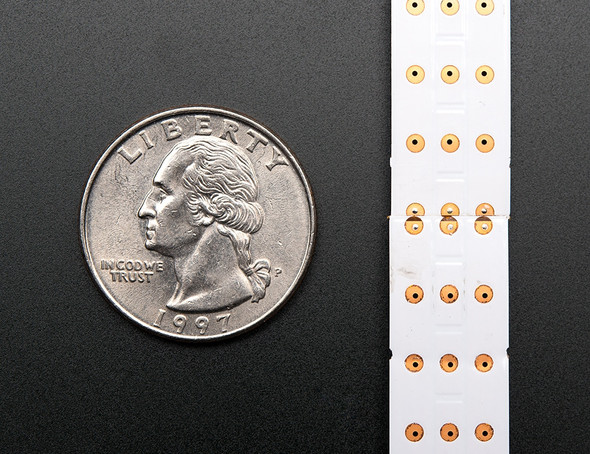
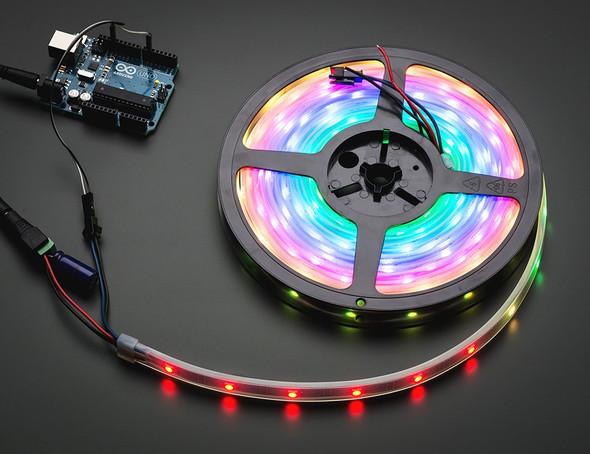
An unbelievable 144 individually-controllable LED pixels on a flexible PCB. It's completely out of control and ready for you to blink. This strip has a black mask, and an extra heavy flex PCB.
These LED strips are even more fun and glowy. There are 144 RGB LEDs per meter, and you can control each LED individually! Yes, that's right, this is the digitally-addressable type of LED strip. You can set the colour of each LED's red, green and blue component with 8-bit PWM precision (so 24-bit colour per pixel). The LEDs are controlled by shift-registers that are chained up and down the strip so you can shorten or lengthen the strip. Only 1 digital out pin is required to send data. The PWM is built into each LED-chip so once you set the colour you can stop talking to the strip and it will continue to PWM all the LEDs for you.
All your high-density LED dreams answered, yet there are a few things to watch for.
All your high-density LED dreams answered, yet there are a few things to watch for.
- First up, the ultra-high density means much higher power usage over a certain distance -35 Watts max (~7 Amps @ 5V). The max rating is assuming all the LEDs are on full white, usually the actual current for colourful design is about 1/3 to 1/2 the max current. A good power supply such as our 5V 10A supply is key!
- Second, to get high density, the controller chip is inside the LED, which is kind of cool, but also means that the chip only uses a single pin for input and a single pin for output. The protocol used is very very timing-specific and can only be controlled by microcontrollers with highly repeatable 100nS timing precision. We have example code for using with the Arduino Uno/Mega microcontroller at 8MHz and 16MHz, but it will not work with the Raspberry Pi, Basic Stamp, NETduino, any other interpreted/virtual machine microprocessor or any processor slower than 8 MHz. For those processors, check our 32 LED/meter digital LED strip which has SPI-like input/output and works well with Pi, NETduino, and other processors.
- Third, just because you have all those pixels doesn't mean you have the RAM for it - the entire strip must be buffered in memory, and we've found many Arduino UNO projects only have about 1500 bytes of RAM available after all the extras are included - enough for about 2-3 meters of the 144 LED pixels. If you want to drive multiple meters and have some other libraries included, use a Mega.
- This strip does not come with a waterproof sheathing, we're working on it but as it's a custom sized strip, the sheathing is custom too. We have no ETA as to when we will have the waterproof version, for now we only have this version available!
These strips are sold by the meter! which may or may not have a connector on it.
To wire up these strips we suggest picking up a 2.1mm DC jack to wire in so you can connect one of our wall adapters to power it. You can connect to the input side with any sort of wire. We don't stock the matching 3-pin JST connector!
To wire up these strips we suggest picking up a 2.1mm DC jack to wire in so you can connect one of our wall adapters to power it. You can connect to the input side with any sort of wire. We don't stock the matching 3-pin JST connector!
Adafruit has an Uberguide has everything you need to use NeoPixels in any shape and size. Including ready-to-go library & example code for the Arduino UNO/Duemilanove/Diecimila, Flora/Micro/Leonardo, Trinket/Gemma, Arduino Due & Arduino Mega/ADK (all versions)
Technical specs:
- 144 LEDs per meter
- Maximum 5V @ 60mA draw per LED (all LEDs on full brightness)
- 5VDC power requirement (do not exceed 6VDC) - no polarity protection!
- 1 integrated RGB LEDs per segment, individually controllable
- LED wavelengths: 630nm/530nm/475nm
- Connector: 3-pin JST SM
- Dimensions: 1000mm / 39.37" x 12mm / 0.47"
- Power Lead: 196.85mm / 7.75"
- Connect Lead: 92.07mm / 3.62"
- Weight: 35.42g
1 Review
-
Title of review 502
Lots of light, performs as advertised, bright enough that it will give you a headache if you don't put a diffuser over it while debugging.Note that only some of Adafruit's docs recommend a series resistor on the data line.
Related Products

Digital RGB LED Strip 144 LED - 1m White - WHITE
Proto-PIC
£36.00
An unbelievable 144 individually-controllable LED pixels on a flexible PCB. It's completely out of control and ready for you to blink. This strip has a white mask, and an extra heavy flex PCB...

Digital RGB LED Weatherproof Strip 60 LED -1m-BLACK
Proto-PIC
£23.00
Digital RGB LED Weatherproof Strip 60 LED -1m-BLACK
You thought it couldn't get better than our world-famous 32-LED-per-meter Digital LED strip but we will prove you wrong! You wanted twice the LEDs?...

Digital RGB LED Weatherproof Strip 30 LED -1m-BLACK
AdaFruit
£16.50
Digital RGB LED Weatherproof Strip 30 LED -1m-BLACK
You thought it couldn't get better than our world-famous 32-LED-per-meter Digital LED strip but we will prove you wrong! These strips have 30...


Digital RGB LED Weatherproof Strip 30 LED -1m - WHITE
AdaFruit
£16.50
Digital RGB LED Weatherproof Strip 30 LED -1m - WHITE
Please note these are sold by the meter
You thought it couldn't get better than our world-famous 32-LED-per-meter Digital LED strip but we will...


Digital RGB LED Weatherproof Strip 60 LED -1m-WHITE
Proto-PIC
£23.00
Digital RGB LED Weatherproof Strip 60 LED -1m-WHITE
You thought it couldn't get better than our world-famous 32-LED-per-meter Digital LED strip but we will prove you wrong! You wanted twice the LEDs?...